Showing posts with label Prose Summer Camp. Show all posts

Wednesday, July 6, 2016

Writing Wednesday: 4 Quick and Easy Ways to Make Your Writing More Interesting

Hello everyone. Happy Canada Day/4th of July/random week in July, and welcome back to Prose Summer Camp!


This is going to be our last Prose Summer Camp post for the year. We've had a really good run these last two months, but I've covered just about everything I wanted to cover about prose level writing, and I'm ready to get back to my true love: obnoxiously over-detailed analysis of big-picture writing issues! Hooray!

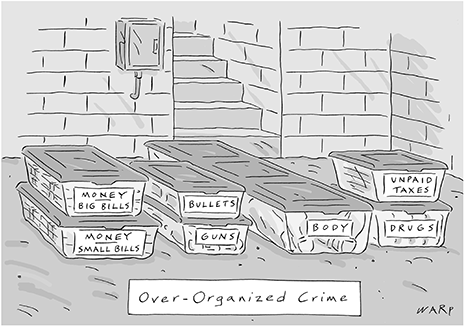
No such thing as too much organization!
Before we go, though, I wanted to talk about the part of prose level I probably think about the most, and that's how to make my actual writing clearer, more readable, and more interesting for my audience.

This is something every writer strives to do. Who doesn't want to make their words more interesting? But while I obviously can't tell you what words to write because I don't know your story or you're style, I have learned a lot of tricks over the years. Some of these have come from editors, some from reading and studying better authors than myself, and a few from my own trial and error.

Big or small, these are all tricks I use in my own novels to get and keep reader attention (or at least keep eyeballs from glazing over). As you'll see, they're all pretty simple. So simple that you might already know them, actually, but fingers crossed that I can deliver something new!

But first, as always, this disclaimer:

**This is how I write. All of the tips below are drawn from my taste and experience as a writer. If you don't like my writing style, knowing how I dress up my paragraphs might not be useful. This is fine! Everyone writes in their own voice. I hope, of course, that you will still find some it helpful, but please don't take any of this as me setting down the One True Path of Writing. I'm just telling you what works for me in the hopes that it might also work for you.**

Now that's clear, let's get to the list!

Writing Wednesday: 4 Quick, Easy Ways to Make Your Writing More Interesting


Wednesday, June 22, 2016

Writing Wednesday: Anatomy of a Scene

Hello everyone, and welcome back to Prose Summer Camp!


Today, we're going to be taking a look at the workhorse of fiction, the scene. But first, announcements!

First, on Monday, Trav had a great post about why you shouldn't price your novel at $0.99. For the record, I absolutely agree with everything he says, but (as we always say around here), our way is not the only way. Case in point, after we posted the article, the awesome and very successful Annie Bellet contacted me on Twitter to tell me that she and several other authors have had fantastic success pricing at $0.99! This lead to a great discussion which I begged her to put into a post, and she gracious obliged. So, next Monday we'll have a guest post from Annie about why you should price your novel at $0.99! I've already read it, and it's going to be awesome.

Secondly, we've added a ton of new posters to the shop! Including this little beauty...

Squeeee!!!

Folks, I've got one in my hands right now, and it is gorgeous! The colors are so much more vibrant than on screen. We've also got posters for the covers and art for One Good Dragon Deserves Another (finally) and No Good Dragon Goes Unpunished as well, and they look just as good. You need more dragons in your life, right? Head on over to the swag shop to take a look and get some special Heartstrikers art for your walls!

Now that's out of the way, let's get down to brass tacks, with...

Prose Summer Camp: Anatomy of a Scene

So far in this series, we've talked about the small, technical details of good writing like improving sentence structure and how to write good sentence level description. We even had Bob come in to help us with dialogue

Now we're going to zoom out a bit and take a look at a larger, but still fundamental, aspect of good novel writing: the scene. As always, though, a disclaimer:

**This is how I write. All of the tips below are drawn from my taste and experience as a writer. If you don't like my writing style, knowing how I plan my scenes might not be useful. This is fine! Everyone writes in their own voice. I hope, of course, that you will still find some it helpful, but please don't take any of this as me setting down the One True Path of Writing. I'm just telling you what works for me in the hopes that it might also work for you.**

Now that's out of the way, let's talk about what a scene can do.

Wednesday, June 8, 2016

Writing Wednesday: Simple Strategies to Vastly Improve Your Sentences

Another summer Wednesday, another Prose Summer Camp! Hooray!

Don't sue me, Forest Service!
Before we get going, though, for all you Heartstrikers readers who might have missed last Monday's post, I'm going to be writing a special Heartstrikers short story in which (not to be too spoiler-tastic) Bethesda is going to be asked many questions. Rather than make up all these questions myself though, I thought it would be fun to open up the floor to you, the readers!

So if you have any questions you'd like the Great and Terrible Bethesda to answer, head on over and leave them in the comments! The best ones (that won't be answered in upcoming books) will be posed to the Heartstriker matriarch herself, so ask away! (And wear flame retardant clothing!)

Now that's covered, back to the post!

Writing Wednesday: Simple Strategies to Vastly Improve Your Sentences

*Disclaimer: This is how I write. All of the tips below are drawn from my taste and experience as a writer. Some of the rules I lay out below are universal, others are stylistic choices. Either way, if you don't like my writing style, seeing how I write my sentences might not be very useful. This is fine! Everyone writes in their own voice. I hope, of course, that you will still find some it helpful, but please don't take any of this as me setting down the One True Path of Writing. I'm just telling you what works for me in the hopes that it might also work for you. Enjoy responsibly!**

So far in Prose Summer Camp, we've talked about how to write better sentence level description and how to write properly formatted, compelling dialogue (with help from everyone's favorite seer!). This week, we're getting even more fundamental with a detailed look at how to buff up actual sentence level writing.

Surprisingly complete. Thanks, internet!

The ability to write a good sentence or paragraph is something that gets brushed over way too often in the genre community. This isn't to say there aren't amazing lyrical writers in genre, there absolutely are, but all too often I see genre writers focusing all of their improvement efforts on the big picture elements--plot, character, world building, all the things that make genre fiction amazing--while ignoring the most basic aspect of good writing: the sentence. It's as though we think that, just because we're not writing literature, bad prose is somehow okay.

Now I'm not saying your paragraphs have to be a staggering works of heartbreaking genius to be good (Lord knows mine aren't), but bad prose is like a dirty bathroom. Sure, the sink might be amazing and the showers might use waterflow methods hither-to unknown to mankind, but if the mirror has toothpaste spit marks on it and there's hairballs on the floor, that fancy stuff doesn't matter. If it looks a mess, no one is going to want to spend any time inside.

This is such a shame, because--like everything else we've covered in this series--bad sentence level writing is one of the easiest problems to fix. I can't tell you how to have better ideas, but I can show you how to write a sentence that reads well, clearly communicates what you're trying to say, and (most importantly) don't distract your reader from all the stuff you wrote this book to talk about in the first place.

Ready? Let's get started!

Wednesday, June 1, 2016

Writing Wednesday: "Hey, Rachel!" the readers cried. "Can you do a post about dialogue?"

Ah, summer. The sun's out, the heat is oppressive, and there are UNINVINTED GUESTS in my house. Clearly, the only thing to do is to break out the swimwear and dive into the nitty gritty details of writing at the prose level. It's,

A badly photoshopped sign using stolen Park Service fonts! No, wait, I mean it's...

Prose Summer Camp!


Yaaay! Today we're going to be focusing on dialogue. Not how to come up with good dialogue (for that, see this post), but how to actually write the stuff in a way that reads well and makes sense on the page. 

Now this might not sound like a big deal, but I can't tell you how many books have been ruined for me by, shall we say, unwise dialogue and dialogue tag choices. Even if the dialogue itself is decent, it's hard to appreciate witty banter when you're trying to figure out how someone can gesticulate a word (are they using Sign Language?). I know that sounds nit picky, but when you're talking about your book, these are your nits to pick. Voice in a book is made up of thousands of nit picky choices just like this. 

Choose well, and no one will notice because they'll be too busy paying attention to your characters and plot. Choose poorly, and the little bad decisions will be all your readers notice. It's like a big old scratch in the paint job of a brand new car. Sure it might not actually change how the car runs, but no one wants to buy a new car with a scratch on it. If you're going to sell that thing, it has to look its best, and this kind of attention to detail is one of the ways we get there.

It should also be noted that these sort of decisions are often considered a stylistic writing choice, which means unless you're really murdering the grammar, no copy editor is going to fix them for you. (And if you are murdering the grammar, you shouldn't be depending on a copy editor to fix that in the first place.) You're the writer here. It's up to you to write well, so let's dig into how we do that.

But first, a disclaimer:

**This is how I write. All of the tips below are drawn from my taste and experience as a writer. Some of the rules I lay out below are universal, others are stylistic choices. Either way, if you don't like my writing style, seeing how I make my dialogue choices might not be very useful. This is fine! Everyone writes in their own voice. I hope, of course, that you will still find some it helpful, but please don't take any of this as me setting down the One True Path of Writing. I'm just telling you what works for me in the hopes that it might also work for you. Enjoy responsibly! **

Now that's out of the way, onward to...

Writing Wednesday: How to (Actually) Write Dialogue


Rachel clapped her hands and looked around the virtual room. "Okay," she said, positively vibrating with grammatical excitement. "Let's talk about writing and talking, my two favorite things! Dialogue in text is one of those writing things we assume everyone just knows. After all, we've all read books before, which means we've seen proper dialogue in action. But seeing isn't always understanding. To truly get what's going on, we have to understand why these authors made the dialogue choices they did."

"And I suppose you're going to tell us?"

Rachel looked up in confusion to see Brohomir, Great Seer of the Heartstrikers, sitting at the back of the room, feeding his pigeon from the tray of complementary snack crackers. "What are you doing here?"

"Shameless self-promotion," Bob said with a grin. "The third volume of my adventures comes out August fifth, and I wanted to make sure everyone in your audience knew they could preorder No Good Dragon Goes Unpunished."

"I don't see how they could have missed it," Rachel said, pointing at the long line of announcement posts, tweets, and other various public declarations. "But since you're already here, how would you like to be my example?"

Bob sighed. "Why are you even asking? You're the writer, and I've already foreseen the end of this little mise en scène. Even if I say no, we both know you're going to make me do it anyway."

"But of course," Rachel said with a cruel grin. "That's the price of being a fan favorite. When the author needs people to pay attention, you get pressed into service." Her smirk widened. "Characters exist to be used."

The dragon seer arched an eyebrow. "Careful," he warned. "Your Bethesda is showing."

Wednesday, May 25, 2016

Writing Wednesday: Five Steps to Writing Better Sentence Level Description

Over the last few weeks I've noticed my Writing Wednesday posts have been getting a bit broad of topic. This is fun for me, I love nothing more than a good wax poetic, but these WW posts are supposed to be about the craft of writing. So, for the next few weeks, I want to get back to basics and really dig into the nitty-gritty, nuts and bolts issues of putting together a good piece of fiction on the sentence and paragraph level.

Why go so small? Well, because there's already tons of information out there on how to do the macro stuff. Just on my blog I have multiple posts about character creation, plotting, tension and pacing, hooking your reader, and so forth.

But despite the obvious importance of these big issues, the problems I see most in books by new authors are not the big ones. It's the little stuff--dull prose, uninspired description, mediocre dialogue--that puts me off first. The book may have major character issues further on, or it may be a work of perfection, but if the sentence level writing is bad, then I'll never get far enough to find out. Life is simply too short to read a badly written book, especially when I have so many other excellent choices as a reader.

Fortunately, these little problems, though book killers if ignored, are some of the easiest to solve in our profession. Motivation, dramatic timing, proper pacing, imaginative plotting, great characters--this stuff is hard. This stuff is art. Learning to writing a nicely put together, functional paragraph? Easy peasy!

This isn't to say writing deathless prose is easy. Quite the opposite. Prose composition is one of those "easy to learn, hard to master" kind of things, which is why you hear stories about literary writers spending years on one paragraph. That said, this level of artistic effort is most definitely not the standard, nor should it be. Some readers love that deep, prose-as-poetry stuff, but there's a vast audience out there that just to read a story told competently and interestingly in a style that doesn't distract from the words are there to say, and that's what we're going to be focusing on in this blog series, which I'm calling Prose Summer Camp!

 'Cause summer. And I love naming things. :)

Ready? Let's tackle the first and perhaps biggest bear on the docket: sentence level description.

Writing Wednesday Prose Summer Camp: Five Steps to Writing Better Sentence Level Description


I've talked about description twice on the blog before: once in a broad "what does description actually do for you?" sort of way, and once with a specific focus on how to describe things in your text without resorting to the dreaded info dump. Everything I said in those posts still applies, but today we're going to look at the fundamentals of writing good description (ie, telling your reader what stuff looks like/feels like/does in an interesting and concise way) as they function on the sentence and paragraph level.

First though, a disclaimer:

**This is how I write. All of the tips below are drawn from my taste and experience as a writer. If you don't like my writing style, knowing how I craft sentences might not be useful. This is fine! Everyone writes in their own voice. I hope, of course, that you will still find some it helpful, but please don't take any of this as me setting down the One True Path of Writing. I'm just telling you what works for me in the hopes that it might also work for you.**

Now that's out of the way, let's talk details.